• demo@admin.com
  • 400-12345-67890
  • 08: 00 - 18: 00 Uhr
Children’s Indoor Play Equipment Design Guide: Activities, Layout & Age-Based Zones
308 06 Feb 2026

Children’s Indoor Play Equipment Design Guide: Activities, Layout & Age-Based Zones

Children’s indoor play equipment is no longer just about slides and ball pits. Today’s indoor playgrounds must deliver engaging play experiences, thoughtful space design, and age-appropriate challenges that meet both children’s developmental needs and parents’ safety expectations.

At Qule Amusement Equipment, we believe that well-designed indoor play equipment should inspire creativity, encourage movement, and support healthy child development—while also helping operators maximize space efficiency and commercial value.

This guide focuses on the most common user-experience and design-related questions surrounding children’s indoor play equipment, offering practical insights for playground investors, designers, and operators.


Why User Experience & Design Matter in Indoor Play Equipment

In competitive indoor entertainment markets, success is driven not only by safety and durability but also by how children and parents experience the space. A well-designed indoor playground:

  • Keeps children engaged for longer periods

  • Encourages repeat visits

  • Supports multiple age groups simultaneously

  • Improves supervision and safety

  • Enhances overall brand perception

User experience design directly affects customer satisfaction, operational efficiency, and long-term profitability.


What Types of Play Activities Should Indoor Play Equipment Include?

High-quality children’s indoor play equipment should offer a balanced mix of physical, cognitive, social, and imaginative play activities. This diversity ensures that children with different interests and abilities all find engaging experiences.

1. Physical Play Activities

Physical play supports strength, coordination, balance, and overall health. Common physical play elements include:

  • Climbing frames and nets

  • Slides of varying heights

  • Obstacle courses

  • Crawl tunnels

  • Trampolines or jumping zones

These activities help children release energy while building confidence and motor skills.

2. Cognitive & Problem-Solving Play

Modern indoor play equipment increasingly incorporates cognitive challenges, such as:

  • Interactive panels

  • Shape and color recognition games

  • Puzzle-based play stations

  • Cause-and-effect activities

These elements stimulate thinking, decision-making, and curiosity.

3. Imaginative & Role-Play Activities

Role-play zones allow children to explore creativity and social roles. Popular examples include:

  • Mini markets or kitchens

  • Castle or adventure themes

  • Space, jungle, or ocean-themed play areas

Imaginative play supports emotional development, storytelling, and social interaction.

4. Social & Cooperative Play

Group activities encourage communication and teamwork. Multi-child play structures, shared challenges, and interactive group games help children learn cooperation and empathy.


How Do I Optimize Indoor Play Space Layout?

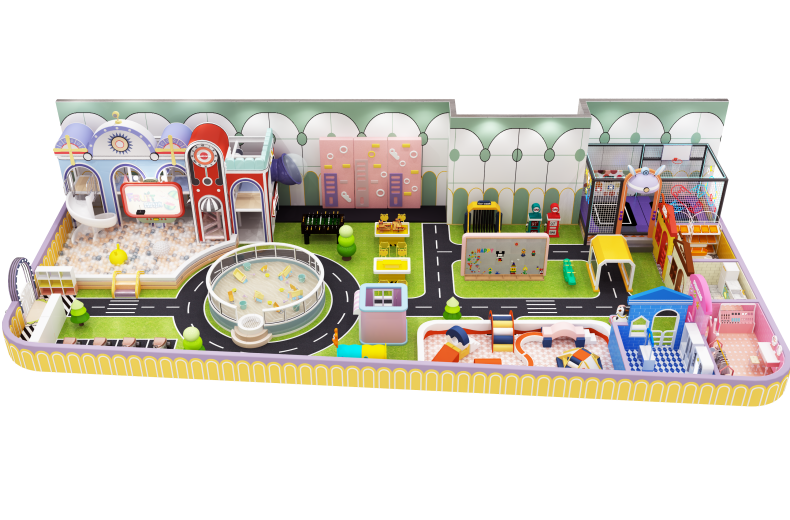
Optimizing layout is one of the most important aspects of children’s indoor play equipment design. A well-planned layout improves safety, circulation, and overall play value—especially in limited spaces.

1. Clear Zoning by Function

Effective indoor playgrounds divide space into functional zones, such as:

  • Toddler zones

  • Active play zones

  • Creative or quiet zones

  • Party or event areas

Clear zoning reduces collisions, improves supervision, and enhances user comfort.

2. Logical Traffic Flow

Children should be able to move naturally from one activity to another without congestion. Designers focus on:

  • Wide pathways

  • Clear entry and exit points

  • Visual openness for staff supervision

3. Vertical Space Utilization

Multi-level structures maximize play value in limited floor space. Vertical design allows operators to:

  • Create layered play experiences

  • Separate age groups vertically

  • Increase capacity without overcrowding

4. Parent Comfort & Visibility

Good layout design considers parents as well. Seating areas, clear sightlines, and rest zones improve the overall family experience and increase dwell time.


How Do I Choose Age-Appropriate Modules and Zones?

Age-appropriate design is essential for both safety and engagement. Children’s indoor play equipment should be carefully segmented based on developmental stages.

1. Toddlers (1–3 Years)

Toddler play areas should feature:

  • Low-height structures

  • Soft foam elements

  • Gentle slides

  • Sensory panels

These zones prioritize safety, exploration, and sensory development.

2. Preschool Children (3–6 Years)

For preschoolers, equipment can be more challenging:

  • Small climbing obstacles

  • Role-play zones

  • Interactive learning panels

This age group benefits from imaginative and semi-structured play.

3. Older Children (6–12 Years)

Older children require more stimulating challenges:

  • Multi-level climbing systems

  • Obstacle courses

  • Competitive or skill-based games

Providing age-appropriate difficulty keeps older children engaged and reduces boredom.


Is Indoor Play Equipment Suitable for Toddlers vs. Older Children?

Yes—but only when properly designed. High-quality children’s indoor play equipment accommodates multiple age groups through thoughtful zoning and differentiated play challenges.

Separate Yet Connected Zones

The most effective designs separate toddlers from older children while still allowing families to stay connected visually. This approach:

  • Prevents accidental collisions

  • Improves safety

  • Enhances comfort for parents

Progressive Play Design

Some indoor playgrounds use progressive layouts, where children naturally move from simple to more complex activities as they grow. This supports long-term customer retention.


The Role of Custom Design in Enhancing Play Experience

Guangzhou Qule Amusement Equipment Co., Ltd. specializes in customized indoor playground solutions that combine safety, creativity, and operational efficiency.

With over 5,000 successful cooperation cases, Qule has designed unique indoor play environments for major theme parks and commercial spaces. Our design process integrates:

  • Child development principles

  • Space optimization strategies

  • Theme-based storytelling

  • Long-term operational considerations

This holistic approach ensures that each project delivers memorable play experiences and sustainable business value.


Frequently Asked Questions (FAQ)

How many play activities should an indoor playground include?

There is no fixed number, but a balanced mix of physical, cognitive, and imaginative activities is recommended.

Can small spaces still offer rich play experiences?

Yes. Vertical design and modular structures allow small venues to deliver high play value.

Should indoor play equipment be updated over time?

Periodic updates and new modules help maintain customer interest and competitiveness.

Is customized design more expensive?

While initial costs may be higher, customized design often results in better space utilization and higher long-term returns.


Design a Better Indoor Play Experience with Qule

User experience and thoughtful design are the foundation of successful children’s indoor play equipment projects.

At Qule Amusement Equipment, we help clients transform spaces into engaging, safe, and profitable indoor playgrounds through professional design and manufacturing expertise.

? Contact us today to receive a customized indoor play equipment design and expert consultation for your project.

Hinterlassen Sie Ihre Nachricht

We use cookie to improve your online experience. By continuing to browse this website, you agree to our use of cookie.

Cookies

Please read our Terms and Conditions and this Policy before accessing or using our Services. If you cannot agree with this Policy or the Terms and Conditions, please do not access or use our Services. If you are located in a jurisdiction outside the European Economic Area, by using our Services, you accept the Terms and Conditions and accept our privacy practices described in this Policy.
We may modify this Policy at any time, without prior notice, and changes may apply to any Personal Information we already hold about you, as well as any new Personal Information collected after the Policy is modified. If we make changes, we will notify you by revising the date at the top of this Policy. We will provide you with advanced notice if we make any material changes to how we collect, use or disclose your Personal Information that impact your rights under this Policy. If you are located in a jurisdiction other than the European Economic Area, the United Kingdom or Switzerland (collectively “European Countries”), your continued access or use of our Services after receiving the notice of changes, constitutes your acknowledgement that you accept the updated Policy. In addition, we may provide you with real time disclosures or additional information about the Personal Information handling practices of specific parts of our Services. Such notices may supplement this Policy or provide you with additional choices about how we process your Personal Information.


Cookies

Cookies are small text files stored on your device when you access most Websites on the internet or open certain emails. Among other things, Cookies allow a Website to recognize your device and remember if you've been to the Website before. Examples of information collected by Cookies include your browser type and the address of the Website from which you arrived at our Website as well as IP address and clickstream behavior (that is the pages you view and the links you click).We use the term cookie to refer to Cookies and technologies that perform a similar function to Cookies (e.g., tags, pixels, web beacons, etc.). Cookies can be read by the originating Website on each subsequent visit and by any other Website that recognizes the cookie. The Website uses Cookies in order to make the Website easier to use, to support a better user experience, including the provision of information and functionality to you, as well as to provide us with information about how the Website is used so that we can make sure it is as up to date, relevant, and error free as we can. Cookies on the Website We use Cookies to personalize your experience when you visit the Site, uniquely identify your computer for security purposes, and enable us and our third-party service providers to serve ads on our behalf across the internet.

We classify Cookies in the following categories:
 ●  Strictly Necessary Cookies
 ●  Performance Cookies
 ●  Functional Cookies
 ●  Targeting Cookies


Cookie List
A cookie is a small piece of data (text file) that a website – when visited by a user – asks your browser to store on your device in order to remember information about you, such as your language preference or login information. Those cookies are set by us and called first-party cookies. We also use third-party cookies – which are cookies from a domain different than the domain of the website you are visiting – for our advertising and marketing efforts. More specifically, we use cookies and other tracking technologies for the following purposes:

Strictly Necessary Cookies
These cookies are necessary for the website to function and cannot be switched off in our systems. They are usually only set in response to actions made by you which amount to a request for services, such as setting your privacy preferences, logging in or filling in forms. You can set your browser to block or alert you about these cookies, but some parts of the site will not then work. These cookies do not store any personally identifiable information.

Functional Cookies
These cookies enable the website to provide enhanced functionality and personalisation. They may be set by us or by third party providers whose services we have added to our pages. If you do not allow these cookies then some or all of these services may not function properly.

Performance Cookies
These cookies allow us to count visits and traffic sources so we can measure and improve the performance of our site. They help us to know which pages are the most and least popular and see how visitors move around the site. All information these cookies collect is aggregated and therefore anonymous. If you do not allow these cookies we will not know when you have visited our site, and will not be able to monitor its performance.

Targeting Cookies
These cookies may be set through our site by our advertising partners. They may be used by those companies to build a profile of your interests and show you relevant adverts on other sites. They do not store directly personal information, but are based on uniquely identifying your browser and internet device. If you do not allow these cookies, you will experience less targeted advertising.

How To Turn Off Cookies
You can choose to restrict or block Cookies through your browser settings at any time. Please note that certain Cookies may be set as soon as you visit the Website, but you can remove them using your browser settings. However, please be aware that restricting or blocking Cookies set on the Website may impact the functionality or performance of the Website or prevent you from using certain services provided through the Website. It will also affect our ability to update the Website to cater for user preferences and improve performance. Cookies within Mobile Applications

We only use Strictly Necessary Cookies on our mobile applications. These Cookies are critical to the functionality of our applications, so if you block or delete these Cookies you may not be able to use the application. These Cookies are not shared with any other application on your mobile device. We never use the Cookies from the mobile application to store personal information about you.

If you have questions or concerns regarding any information in this Privacy Policy, please contact us by email at . You can also contact us via our customer service at our Site.