• demo@admin.com
  • 400-12345-67890
  • 上午08:00-下午6:00
Children’s Indoor Playground Planning & Design Guide: Space Requirements, Ceiling Height & Location Strategy (2026)
845 01 Mar 2026

Children’s Indoor Playground Planning & Design Guide: Space Requirements, Ceiling Height & Location Strategy (2026)

If you are planning to invest in a Children’s indoor playground, the most critical stage of your project is planning and design. A well-designed children’s indoor playground is not just about colorful slides and ball pits—it is a carefully calculated combination of space planning, ceiling height evaluation, zoning strategy, safety compliance, and location selection.

Whether you are opening a small community play area or a large commercial family entertainment center, proper planning directly determines:

  • ✅ Customer flow and capacity

  • ✅ Safety and compliance

  • ✅ Investment efficiency

  • ✅ Long-term profitability

  • ✅ Brand competitiveness

In this comprehensive 2026 guide, we will answer the most important questions:

  • How much space do you need for an indoor playground?

  • How to design a children's indoor playground?

  • What is the minimum ceiling height required?

  • How to choose the right location for your indoor playground business?

We will also share professional insights from Guangzhou Qule Amusement Equipment Co., Ltd., a direct manufacturer with over 5,000 cooperation cases worldwide.


Table of Contents

  1. Why Proper Planning Is Critical for a Children’s Indoor Playground

  2. How Much Space Do You Need for an Indoor Playground?

  3. How to Design a Children’s Indoor Playground?

  4. What Is the Minimum Ceiling Height for an Indoor Playground?

  5. How to Choose the Right Location for an Indoor Playground Business?

  6. Professional Planning with Guangzhou Qule Amusement Equipment Co., Ltd.

  7. Common Mistakes to Avoid in Planning

  8. FAQ – Children’s Indoor Playground Planning & Design

  9. Start Your Children’s Indoor Playground Project Today


Why Proper Planning Is Critical for a Children’s Indoor Playground

The children’s indoor playground industry has evolved significantly. Modern parents expect:

  • Safe and certified equipment

  • Clean and comfortable environments

  • Age-appropriate zones

  • Interactive and themed experiences

  • Instagram-worthy design

A poorly planned space can lead to:

  • Low customer retention

  • Safety risks

  • Poor traffic flow

  • Underutilized areas

  • Revenue loss

That’s why professional planning is the foundation of success.

At Guangzhou Qule Amusement Equipment Co., Ltd., we integrate:

  • In-house R&D

  • Custom design services

  • IP & theming solutions

  • Turnkey project execution

From concept to installation, we ensure every children’s indoor playground is optimized for safety, efficiency, and profitability.


1. How Much Space Do You Need for an Indoor Playground?

One of the most common questions investors ask is:

“What size is ideal for a children’s indoor playground?”

The answer depends on your business model and target market.

✅ Small Indoor Playground (20–150㎡)

Suitable for:

  • Residential communities

  • Small shopping centers

  • Parent-child stores

  • Kindergartens

Advantages:

  • Lower initial investment

  • Lower rent cost

  • Easier management

  • Faster return on investment

Typical Capacity: 20–40 children simultaneously

✅ Medium Indoor Playground (150–500㎡)

Suitable for:

  • Shopping malls

  • Commercial complexes

  • Family entertainment centers

Advantages:

  • Balanced risk and profit

  • Multiple play zones

  • Party room potential

  • Higher ticket price

Typical Capacity: 50–120 children simultaneously

This size range is often considered the most profitable model for new investors.

✅ Large Indoor Playground (500–2000㎡+)

Suitable for:

  • Large malls

  • Theme park complexes

  • Independent indoor amusement centers

Advantages:

  • Strong brand image

  • High customer attraction

  • Advanced IP theming

  • Multi-revenue model

Typical Capacity: 150+ children simultaneously

Space Planning Formula

A professional rule of thumb:

  • Allocate 2–4㎡ per child for comfortable play

  • Include 20–30% of total space for non-play areas

Non-play areas include:

  • Reception

  • Shoe storage

  • Parent lounge

  • Party rooms

  • Storage rooms

  • Staff area

Proper spatial distribution maximizes both safety and revenue.


2. How to Design a Children’s Indoor Playground?

Designing a children’s indoor playground is not simply placing equipment into a space. It requires systematic planning and professional expertise.

Step 1: Define Your Target Age Group

Age zoning is essential for safety and experience.

Common Age Divisions:

  • 1–3 years (Toddler Zone)

  • 3–6 years (Exploration Zone)

  • 6–12 years (Adventure Zone)

Each age group requires different:

  • Equipment height

  • Activity complexity

  • Safety padding

  • Challenge level

Step 2: Functional Zoning Layout

A well-designed children’s indoor playground typically includes:

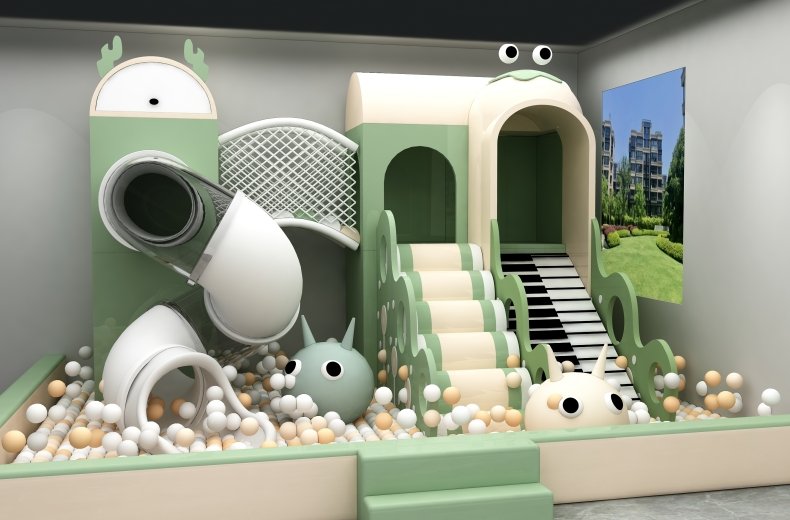
✅ Soft Play Structure Area

  • Slides

  • Climbing nets

  • Ball pools

  • Tunnels

  • Obstacle courses

✅ Toddler Soft Zone

  • Low-height structures

  • Foam climbing blocks

  • Sensory panels

✅ Adventure Zone

  • Climbing walls

  • Rope courses

  • Interactive challenges

✅ Party Room

Birthday events are a major revenue source.

✅ Parent Lounge

Comfortable seating increases dwell time.

Step 3: Traffic Flow Design

  • Clear entry and exit points

  • Emergency evacuation access

  • Visual supervision from parents

  • Smooth circulation paths

Step 4: Theming & IP Design

Modern children’s indoor playgrounds require strong visual identity.

  • Custom IP concept development

  • Cultural-themed designs

  • Branded immersive environments

Themed playgrounds increase ticket pricing potential and improve brand memorability.

Step 5: Safety Compliance

  • Non-toxic materials

  • High-strength steel structures

  • Soft padding systems

  • International safety standards


3. What Is the Minimum Ceiling Height for an Indoor Playground?

✅ Minimum Recommended Ceiling Height

  • Minimum workable height: 2.6 meters (8.5 ft)

  • Recommended height: 3.5–6 meters (11–20 ft)

  • Ideal for multi-level structures: 5 meters+

Why Ceiling Height Matters

  • Determines equipment complexity

  • Impacts visual openness

  • Affects ventilation and comfort

  • Influences customer perception

Higher ceilings allow multi-story play structures, spiral slides, and net climbing towers.


4. How to Choose the Right Location for an Indoor Playground Business?

✅ High Traffic Areas

  • Shopping malls

  • Commercial complexes

  • Supermarkets

  • Residential communities

  • Parent-child centers

✅ Target Demographics

  • Number of families with children

  • Age distribution

  • Income level

  • Competing playgrounds nearby

✅ Visibility & Accessibility

  • Clear storefront visibility

  • Elevator access

  • Parking convenience

  • Nearby anchor tenants

✅ Rental Cost vs Revenue Potential

Calculate expected foot traffic before signing a lease.


Professional Planning with Guangzhou Qule Amusement Equipment Co., Ltd.

Guangzhou Qule Amusement Equipment Co., Ltd. specializes in research, design, production, sales, and chain investment operation of children's amusement products.

  • Over 5,000 cooperation cases

  • Safe and innovative equipment

  • Customized themed playground solutions

  • One-on-one professional design

  • Standardized installation

  • Lifetime after-sales support

  • Rapid response commitment


Common Mistakes to Avoid in Planning

  • Ignoring ceiling height limitations

  • Underestimating storage and utility space

  • Overcrowding equipment

  • Skipping professional safety consultation

  • Choosing location based on rent only


FAQ – Children’s Indoor Playground Planning & Design

1. What is the best size for a first-time investor?

150–300㎡ is often the safest balance between cost and profitability.

2. Can a small 50㎡ space work?

Yes, especially in residential communities with strong family density.

3. How long does planning and design take?

Usually 7–15 days for initial layout, depending on customization level.

4. Do you provide site evaluation support?

Yes. Qule offers professional investment and planning guidance.

5. Can the playground be customized to local culture?

Absolutely. We specialize in IP & themed customized projects.

6. What venues are suitable?

  • Hotels

  • Shopping malls

  • Parent-child centers

  • Amusement parks

7. How do I ensure long-term competitiveness?

  • Themed branding

  • Regular updates

  • Strong safety standards

  • Professional operational strategy


? Start Your Children’s Indoor Playground Project Today

Ready to build your own Children’s Indoor Playground?

Work with Guangzhou Qule Amusement Equipment Co., Ltd., a trusted global manufacturer with extensive experience and factory-direct advantages.

  • ✅ Free project consultation

  • ✅ Customized layout design

  • ✅ Competitive pricing

  • ✅ Full turnkey support

  • ✅ Lifetime after-sales service

? Visit: https://qulegood.com
? Email: sales@quleamusement.com
? Phone/WhatsApp: +86 13302266676

Let’s build a colorful childhood and create joyful experiences for children around the world. 

留下您的信息

We use cookie to improve your online experience. By continuing to browse this website, you agree to our use of cookie.

Cookies

Please read our Terms and Conditions and this Policy before accessing or using our Services. If you cannot agree with this Policy or the Terms and Conditions, please do not access or use our Services. If you are located in a jurisdiction outside the European Economic Area, by using our Services, you accept the Terms and Conditions and accept our privacy practices described in this Policy.
We may modify this Policy at any time, without prior notice, and changes may apply to any Personal Information we already hold about you, as well as any new Personal Information collected after the Policy is modified. If we make changes, we will notify you by revising the date at the top of this Policy. We will provide you with advanced notice if we make any material changes to how we collect, use or disclose your Personal Information that impact your rights under this Policy. If you are located in a jurisdiction other than the European Economic Area, the United Kingdom or Switzerland (collectively “European Countries”), your continued access or use of our Services after receiving the notice of changes, constitutes your acknowledgement that you accept the updated Policy. In addition, we may provide you with real time disclosures or additional information about the Personal Information handling practices of specific parts of our Services. Such notices may supplement this Policy or provide you with additional choices about how we process your Personal Information.


Cookies

Cookies are small text files stored on your device when you access most Websites on the internet or open certain emails. Among other things, Cookies allow a Website to recognize your device and remember if you've been to the Website before. Examples of information collected by Cookies include your browser type and the address of the Website from which you arrived at our Website as well as IP address and clickstream behavior (that is the pages you view and the links you click).We use the term cookie to refer to Cookies and technologies that perform a similar function to Cookies (e.g., tags, pixels, web beacons, etc.). Cookies can be read by the originating Website on each subsequent visit and by any other Website that recognizes the cookie. The Website uses Cookies in order to make the Website easier to use, to support a better user experience, including the provision of information and functionality to you, as well as to provide us with information about how the Website is used so that we can make sure it is as up to date, relevant, and error free as we can. Cookies on the Website We use Cookies to personalize your experience when you visit the Site, uniquely identify your computer for security purposes, and enable us and our third-party service providers to serve ads on our behalf across the internet.

We classify Cookies in the following categories:
 ●  Strictly Necessary Cookies
 ●  Performance Cookies
 ●  Functional Cookies
 ●  Targeting Cookies


Cookie List
A cookie is a small piece of data (text file) that a website – when visited by a user – asks your browser to store on your device in order to remember information about you, such as your language preference or login information. Those cookies are set by us and called first-party cookies. We also use third-party cookies – which are cookies from a domain different than the domain of the website you are visiting – for our advertising and marketing efforts. More specifically, we use cookies and other tracking technologies for the following purposes:

Strictly Necessary Cookies
These cookies are necessary for the website to function and cannot be switched off in our systems. They are usually only set in response to actions made by you which amount to a request for services, such as setting your privacy preferences, logging in or filling in forms. You can set your browser to block or alert you about these cookies, but some parts of the site will not then work. These cookies do not store any personally identifiable information.

Functional Cookies
These cookies enable the website to provide enhanced functionality and personalisation. They may be set by us or by third party providers whose services we have added to our pages. If you do not allow these cookies then some or all of these services may not function properly.

Performance Cookies
These cookies allow us to count visits and traffic sources so we can measure and improve the performance of our site. They help us to know which pages are the most and least popular and see how visitors move around the site. All information these cookies collect is aggregated and therefore anonymous. If you do not allow these cookies we will not know when you have visited our site, and will not be able to monitor its performance.

Targeting Cookies
These cookies may be set through our site by our advertising partners. They may be used by those companies to build a profile of your interests and show you relevant adverts on other sites. They do not store directly personal information, but are based on uniquely identifying your browser and internet device. If you do not allow these cookies, you will experience less targeted advertising.

How To Turn Off Cookies
You can choose to restrict or block Cookies through your browser settings at any time. Please note that certain Cookies may be set as soon as you visit the Website, but you can remove them using your browser settings. However, please be aware that restricting or blocking Cookies set on the Website may impact the functionality or performance of the Website or prevent you from using certain services provided through the Website. It will also affect our ability to update the Website to cater for user preferences and improve performance. Cookies within Mobile Applications

We only use Strictly Necessary Cookies on our mobile applications. These Cookies are critical to the functionality of our applications, so if you block or delete these Cookies you may not be able to use the application. These Cookies are not shared with any other application on your mobile device. We never use the Cookies from the mobile application to store personal information about you.

If you have questions or concerns regarding any information in this Privacy Policy, please contact us by email at . You can also contact us via our customer service at our Site.